Friday, October 30, 2015

Female Adventurers

Here is a quartet of female adventurers from Reaper Bones plastic. Below, a female paladin and wizard, both ready for some Frostgrave action.

The caster is from Bones I, and the problem with indistinct facial details are particularly noticeable on that figure. The severity may vary from figure to figure, but it has improved on the most recent Bones release.


Below, the two female adventurers from the Dragons Don't Share set. Fine details on the face and clothing are noticeably better here. 


The two face off against a Warg, also from Reaper Bones. The terrain tiles are by Acheson Creations. Cast in a hard plastic, they paint up very nicely and will work in a variety of situations. Check for updates later.


Sunday, October 18, 2015

More Burrows and Badgers from Oathsworn

I completed six more of Oathsworn's Burrows and Badgers miniatures last week. These figures were my favorite acquisition of 2015 to this point.

Anthropomorphic has suffered a bit because of the whole "furry" thing, but nonetheless, I am a fan Oathsworn's product. Their aesthetic is favors the animal rather than human form, matching the look of Disney's Robin Hood or the Redwall series.

The sculpts and castings are very clean; like great animation, Oathsworn's designs are built from bold lines and dynamic composition, rather than over-elaborate details and ridiculous poses.


Shrew Warrior, Mole Friar, Ferret Rogue 


Mole Warrioress, Hedgehog Warrioress, Black Rat Warrior

Tuesday, October 13, 2015

Oriental Adventures into 5E Part Two: Hengeyokai

Continuing my conversation of the 1985 Oriental Adventures into D&D 5th Edition, here are the Hengeyokai. I am currently preparing to GM a campaign set in an original Asian-inspired setting.


Hengeyokai from Stonehaven Miniatures
L to R: Male Fox Ranger/Rogue, Bluebird Rogue, Sparrow Bard & Female Fox Assassin 

HENGEYOKAI


Hengeyokai are intelligent, shape-shifting animals. The ability to change is natural to hengeyokai. The are not lycanthropes and do not have the weakness and resistances of lycanthropes. In a sense, Hengeyokai are animals who become human, rather than humans who become animals.
Hengeyokai have three forms that they can assume. The first is a normal animal of their type, the second is a bipedal animal and the third is a human form. In human form, the hengeyokai retains some characteristic of their animal form. A hengeyokai crane for example, might be exceptionally long-legged. A hengeyokai rat might have a long nose.  Their bipedal form is their most natural
Hengeyokai typically do not have their own kingdoms and settlements, and live in a variety of places depending on their type. Rats might live in the lower reaches and poorer parts of cities, while monkeys might be found as hermits in a forest. Humans are generally suspicious of hengeyokai, even those that they know to be traditionally good.
HENGEYOKAI TRAITS


Your Hengeyokai character has a variety of characteristics in common with all other Hengeyokai, and other traits based on your animal type.
Ability Score Increase: Your ability scores increase depending on the animal form.
Age. Hengeyokai mature at the same rate as humans and have roughly the same lifespans with some variations among animal types.
Size. In human form, hengeyokai are Medium.  
Alignment. The majority of Hengeyokai are chaotic or neutral. Certain animal types have a tendency to good or evil, and this might form an important part of your background.
Speed. Your base walking speed in human form is 30 feet.
Type. You are of the Monstrosity type.
Darkvision. In animal and bipedal form, you have superior vision in the dark. You can see in dim light within 60 feet as if you were in bright light, and in darkness as if it were dim light. You cannot identify color in the darkness, only shades of grey. In human form, you lack darkvision.
Attracts Suspicion. In bipedal form, all Charisma checks with humans are made at a disadvantage.
Languages. You can speak, read and write Hengeyokai, Common and Spirit Folk. In animal form, you can understand any language you already know, though you can only speak in hengeyokai. In bipedal form, you can speak any language you know, including human and animal languages. In human form, you cannot speak to animals but can understand their communication.
Shifting. As an action, you may shift into a different form.  This ability is limited, however. The number of times a hengeyokai can change forms in one day equals his class level. A first level character who is a hengeyokai can change from human to animal form on one day, and must remain in that form until the next day. He could then change into the human or bipedal form. Changing requires one complete round during which a hengeyokai must maintain concentration. Armor, clothing and equipment do not change with the hengeyokai, although most are retained and usable in the human and bipedal forms.
Animal Form. When in animal form, a hengeyokai is virtually indistinguishable from a normal animal. Since the form is natural and not an illusion, spells that reveal illusions will not detect a hengeyokai. In animal form, hengeyokai cannot wear armor or use weapons. Hengeyokai spell casters cannot cast any spells while in animal form.
The hengeyokai has fewer hit points while in animal form than in either of his other forms. In animal form, the hengeyokai only has half their current hit points (rounded up). Hit points lost in one form are carried over to another form. For example,  a hengeyokai with 25 hit points in human form will have 13 in animal form. If the character is wounded and loses 5 hit points, he will have 20 upon returning to human or bipedal form.
When a hengeyokai reaches 0 hit points in any form, they must make death saving throws as per the PH. Shifting to another form will not regain hit points in such a state.
Bipedal Form. In this form, the hengeyokai appears as a humanoid animal. He stands on hind legs at roughly the same height as his human form. The front paws (or wings, fins, etc.) change into hands capable of gripping and using equipment. The rest of the body retains the general shape and appearance of the animal, including fur, feathers, tail and other characteristic features.

Creature
Attack/Damage
AC
Move
Ability Scores
Carp
-
Swim 30
+2 WI, +1 CON
Cat
1-3/slashing
12
Move 40, Climb 30
+2 DEX, +1 CHR
Crab
1-3
11
Move 20, Swim 20
+2 STR, +1 CON
Crane
-
Move 10, Fly 40
+2 WIS, +1 CHR
Dog
1-3/piercing
12
Move 40
+2 CON, +1 STR
Drake
-
Move 20, Fly 40, Swim 20
+2 CHR, +1 CON
Fox
bite, +1 to hit  (1d4-1) piercing
12
Move 40
+2 INT, +1 CHR
Hare
12
Move 40
+2 WIS, +1 DEX
Monkey
bite, +1 to hit (1d4-1)  piercing
12
Move 30, Climb 30
+2 DEX, +1 INT
Raccoon Dog
bite, +2 to hit (1d4-1)  piercing
10
Move 20, Climb 20
+2 STR, +1 DEX
Rat
bite, +0 to hit, 1 piercing
10
Move 20
+2 CON, +1 INT
Sparrow
+3 to hit, 1 piercing
12
Move 10, Fly 40
+2 CHR, +1 DEX

Damage. Listings are given for animals with natural weapons (teeth or claws). Natural weapons can only be used when the hengeyokai is in animal form, now when the character is in human or bipedal form.
Armor Class (AC) only applies to the animal form, not to the bipedal or human form. It cannot be increased by armor or shields.
Move indicates the character’s speed in animal form and the types
Modifications indicates the changes to a character’s ability scores based on the type of creature chosen.
Hare. In animal and bipedal form, the hengeyokai has Advantage on Perception checks that involve hearing.
Monkey. In animal and bipedal form, the hengeyokai has a prehensile tail that can manipulate and lift small object. It cannot be used to directly attack.
Raccoon Dog. In animal and bipedal form, the hengeyokai has Advantage on perception checks that rely on smell.
Rat. In animal and bipedal form, the hengeyokai has advantage on perception (smell) checks.
Sparrow. In bipedal and human form, the hengeyokai is proficient in Musical Instrument (Voice). In both bipedal and human form, their tendency is to be a Small size.

Wednesday, September 30, 2015

Fire & Ice: Reaper minis for Frostgrave

This week I worked on my Reaper I backlog, in part due to some Frostgrave inspiration.

First, the fire elemental which is cast in red translucent plastic. I held back on this mini because I had some plan of drilling out the bottom and installing an LED. No shortage of examples are out there on the web, but I pretty much decided that after two years that was a project that would never get off the backburner.

So, here it is, ready for summoning by an elemental wizard. I quickly applied some basic yellow highlights with hot ash and coal on the base. 


I really like this Frostgiant Princess, although it looks more like a shaman than a noble. Some of the design elements have an Inuit influence, or possibly Saami. 


Monday, September 21, 2015

Oriental Adventures into 5th Edition: Korobokuru


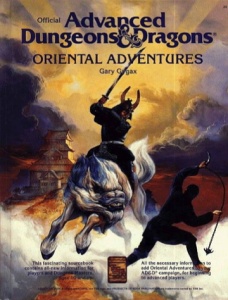
     Oriental Adventures came in 1985 at the tail end of the 1st edition/AD&D era. Released as a hardcover, it introduced many concepts such as skill proficiency, comeliness, and honor. Of course, the real draw was new classes such ninja, samurai and wu jen. Other classes, such as barbarian and monk were repurposed to better fit the new setting. To an 11 or 12 year old who grew up on Kung Fu Theater every Saturday afternoon, this was a prize. From the classic cover to an Asian bestiary, this is an AD&D collector's essential..
       The setting of Kaan-Tur was initially meant to be the Oriental end of a generic European medieval world, probably Greyhawk. In 1987, it was specifically stated to be in the Forgotten Realms. A later edition of Oriental Adventures (for 3E) would place the story in Rokugon, of Legend of the Five Rings Fame. A good book, but one that was at cross purposes with itself. Many of the races and classes it contained were not a part of the setting the book described, and so the book never worked to a coherent whole.
The original Oriental Adventures contained only three non-human player character races, all of which I will adapt in the coming weeks.  First, the dwarves of Kara-tur:

KOROBOKURU

The Korobukuru are a race of eastern dwarves who make their home deep in the jungle, on snowy mountains or in remote forests.  They rarely venture outside of their villages, and avoid contact with humans and other intelligent races.
Dwarf monk from Reaper Miniatures
Standing about 4 feet tall, the Korobokuru are nonetheless stout and powerful. Their long, hairy arms and slightly bowed legs and sparse beards give them a comical appearance to many humans. Nonetheless, they are extremely strong and hardy
Korobokuru live in small settlements where they farm, hunt and work at simple crafts. They are often considered primitive by settled and more advanced peoples, though the korobokuru’s pugnacious and boastful nature will not tolerate insults. Korobokuru adventurers who travel outside of their villages are most often barbarians, but might also include rangers and druids.  
KOROBOKURU NAMES


Names are very important in Korobokuru culture. In addition to the clan name, parents give children a name or nickname at an early age. Upon reaching adulthood, another name is taken, which is mostly kept secret. Only very close family members or companions are told this secret name.
Male Names. Akihi, Horohoro, Isonash, Koshaman, Menkakush, Mici, Nupur, Pasekur, Resak, Takhaka,
Female Names. Api, Hotene, Katekemat, Kateyui, Mina, Oki, Opere, Nupeki, Pirka, Saki, Toitoi, Umoshmatek,
Clan Names. Hakket, Jomo, Kapo, Karafuto, Niputay, Ponape, Yezo,

KOROBOKURU TRAITS


Your Korobokuru character has a variety of characteristics in common with all other Korobokuru.
Ability Score Increase: Your Constitution Score increases by 2 and your Strength increases by 1.
Age. Korobokuru mature at the same rate as humans, but they are considered young until they are 50 years of age. On average, they live about 350 years, although rare ascetics among them may live much longer.
Size. Korobokuru stand between 3 ½ to 4 ½ feet tall and average about 125 lbs. Your size is Small.
Alignment. The majority of Korobokuru are chaotic or neutral, especially in their relations with outsiders.
Speed. Your base walking speed is 25 feet.
Type. You are of the humanoid type.
Darkvision. Accustomed to the dark forests and the night sky, you have superior vision in the dark. You can see in dim light within 60 feet as if you were in bright light, and in darkness as if it were dim light. You cannot identify color in the darkness, only shades of grey.
Resilience. You have advantage on saving throws against poison and you have resistance to poison damage.
Hardy. You have advantage on all Strength and Constitution saves against magic.
Toughness. Your hit point maximum increases by 1, and it increases by 1 every time you gain a level.  
Languages. You can speak Korobokuru, Trade and Hengeyokai.
Close to the Wild. You have proficiency in the Nature skill. If attempting to identify plants and animals of your clan's native area, you have Advantage on skill checks.

Oriental Adventures for AD & D at rpgnow.com

Conversion notes: This is basically a 5th edition hill dwarf with a few changes. They have the nature proficiency instead of a tool proficiency. A couple of gnomish traits (small size and magical resistance) replace the armor and weapon proficiencies and bonuses. The names are borrowed and adapted from Ainu names. Korobokuru are a part of Ainu folklore and the Ainu thought the dwarves were the previous inhabitants of their northern islands. 

Goblin Villagers

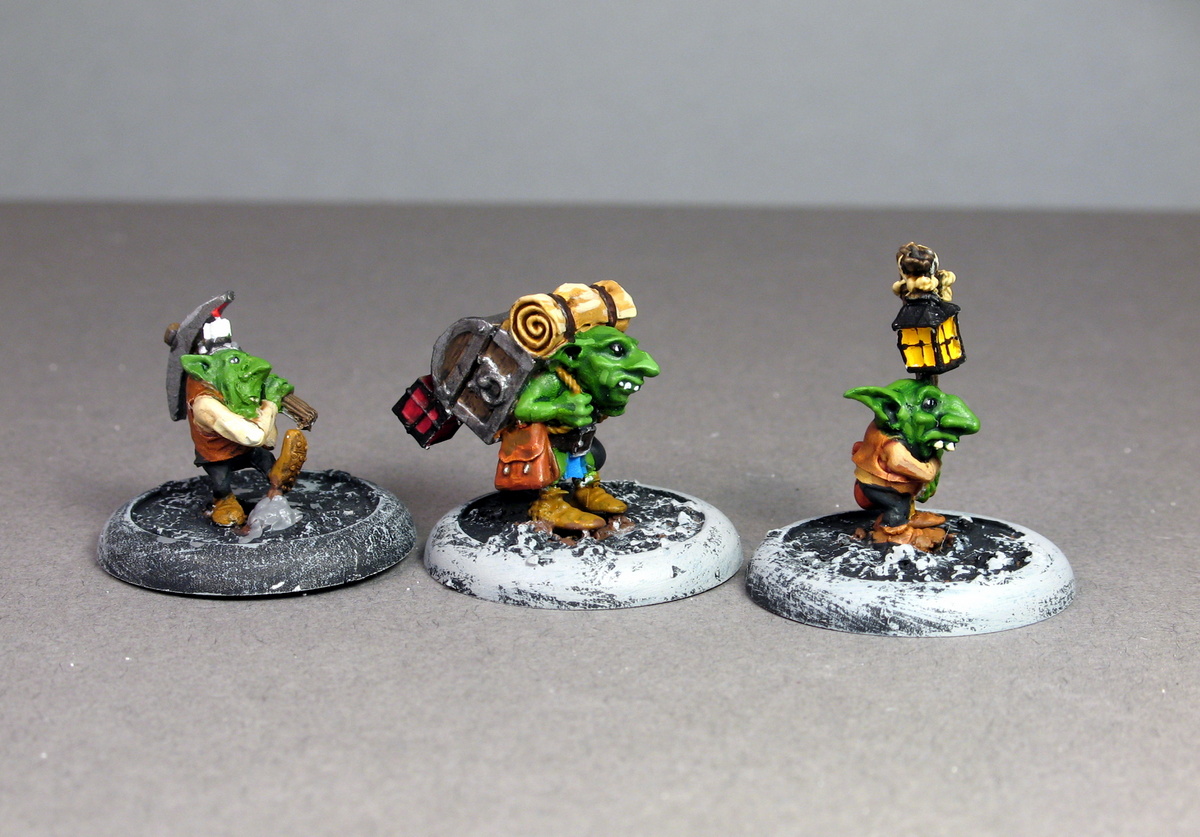
My painting project for the week were these goblins from Rebel Minis from their Dark Hold line. They are 20mm to the top of the head. The sculptor is Bobby Jackson, and as you can see, the poses, character and expression is excellent. The casting is also top quality. Very little clean up required, and all are single piece figures.


I will possibly make use of them in a Frostgrave warband. They would certainly be very good low level minions for an unscrupulous wizard.

Order Rebel Minis

Thursday, September 3, 2015

As the Crow Flies - Stonehaven Miniatures' Tengu

This week brings me to three more completed figures from Stonehaven's Half-Orc Kickstarter. Obviously, these are not Half-Orcs, but Stonehaven always adds extra character types to its themed Kickstarters. In some cases, they are the most interesting of the figures. 

The Tengu, bird people from Japanese mythology, can be found as a PC race in a number of RPGs. On a recent D&D poll, they were listed on a ballot as a possible race in 5E. Here's my vote for an Unearthed Arcana bringing back some of the old school Oriental Adventures. Wait, can we still say Oriental? 

From the left, a mage, samurai and harrier. If I was doing 5E characters, I would play them as a sorcerer, fighter battlemaster and rogue thief respectively. As it stands, I will probably put together a Tengu warband for Open Combat. 


Stonehaven Miniatures make great characters and their is definitely a unique aesthetic to their figures. One can see a trace of humor and playfulness in the sculpts without making an ironic joke - which is what I perceive to be behind the whole Chibi style movement. The production quality is excellent. Mold lines are minimal and easily cleaned.

These figures, especially the larger two, have a lateral flatness common to many of Stonehaven's miniatures, no doubt to ease in the casting process. It is a minor detriment to an otherwise excellent and growing line of figures.

Saturday, August 29, 2015

Frostgrave


Frostgrave is the mini hit of the summer, and I have certainly fell under its spell. Part of its appeal was that, like Open Combat, any miniatures could be used. With plenty of Reaper Bones on hand, I bought the rulebook, and passed on the official wizard and soldier minis.

That was the plan, but the book was illustrated with so many beautifully painted miniatures that I gave in and ordered the box of plastic figures from Brigade Games.

The sprues are well stocked with so many options that one could assemble all 20 with no noticeable repetition. The two handed weapons (great sword, battle axe) will be in my next batch.


Here is my planned warband - a Sigilist wizard and his apprentice, both from Reaper. The plastic miniatures are closer to the 28mm standard used by historical manufacturers. In fact, many of their arms and weapons will fit with Gripping Beast's plastic figures. I'll post some examples next week. But as you can see below, many fantasy manufacturers tend towards the taller side of 28mm (really 32mm). The two don't necessarily look out of place together, but there is a noticeable differential. 


I have also been busy assembling some Frostgrave terrain from my Hirst Art blocks. One of the nice things about building ruined terrain is that I don't have to use clamp and guides to line up the blocks straight and true. Buckled walls, gaps and other irregularities are the desired outcome in this case.